
Emma Katz* School of Social Sciences, Liverpool, Hope University, UK. Anna Nikupeteri.Merja Laitinen Faculty of Social Sciences, Universityof Lapland, Rovaniemi, Finland
Child Abuse Review Vol. 29: 310–324 (2020)
Published online 19 May 2020 in Wiley Online Library
(wileyonlinelibrary.com) DOI: 10.1002/car.2611
“This article shows how domestic violence perpetrators can use coercive control against their children after their ex-partner has separated from them. Coercive control can include violence, threats, intimidation, stalking, monitoring, emotional abuse and manipulation, interwoven with periods of seemingly ‘caring’ and ‘indulgent’ behaviour as part of the overall abuse. Crucially, what this article provides is knowledge, hitherto largely missing, about how children and young people can experience coercive control post-separation. The article draws on two separate data sets, one from the UK and one from Finland, which together comprise qualitative interviews with 29 children who had coercive control perpetrating fathers/father-figures. The data sets were separately thematically analysed, then combined using a qualitative interpretative meta-synthesis. This produced three themes regarding children’s experiences: (1) dangerous fathering that frightened children and made them feel unsafe; (2) ‘admirable’ fathering, where fathers/father-figures appeared as ‘caring’, ‘concerned’, ‘indulgent’ and/or ‘vulnerable-victims’; and (3) omnipresent fathering that continually constrained children’s lives. Dangerous and ‘admirable’ fathering describe the behaviours of coercive control-perpetrating fathers/father-figures, while omnipresent fathering occurred in children as a fearful mental and emotional state. Perpetrators could also direct performances of ‘admirable’ fathering at professionals and communities in ways that obscured their coercive control. Implications for policy and practice are discussed. © 2020 The Authors. Child Abuse Review published by Association of Child Protection Professionals and John Wiley & Sons Ltd
Key Practitioner Messages:
- Children and young people can be direct victims/survivors of coercive control and they can experience it in much the same ways as adults do – feeling confused and afraid, living constrained lives, and being entrapped and harmed by the perpetrator.
- Coercive control can harm children and young people emotionally/psychologically, physically, socially and educationally.
- Robust measures are required to deal with coercive control perpetrating fathers/ father-figures, in order to prevent them from using father–child relationships to
continue imposing coercive control on children and ex-partners.”
Introduction
This article addresses a gap in thinking on coercive control in the postseparation
phase of domestic violence. Drawing on the accounts of
children and young people themselves, it shows how children can continue
to be harmed by their father’s/father figure’s use of coercive control after their
mother’s separation from him. It explores how, in the post-separation phase,
fathers/father figures can use the same tactics of coercive control against their
children that they use against their ex-partners, causing children the same kinds
of psychological and emotional harm and constraining their lives.
In the UK, governments are increasingly recognising that controlling and
coercive behaviour is central to domestic violence. In 2015, s. 76 of the Serious
Crime Act made coercive or controlling behaviour in a family or intimate
relationship a criminal offence in England and Wales. This development has
promoted greater awareness in the UK that domestic violence is not primarily
about incidents of violence, but is often a pattern of controlling and coercive
behaviours used by perpetrators over an extended time period to control and
dominate another person/persons (Stark, 2007; Stark and Hester, 2019).
Finnish law has not criminalised coercive control, but there is growing
awareness of its harmfulness among Finnish professionals in the domestic
violence field.
This article seeks to extend academic and professional knowledge on
children’s experiences of coercive control perpetrated by fathers/father figures.
Despite wide recognition that children and young people are affected by
domestic violence, only a small number of studies have explicitly explored
how they are affected by coercive control (e.g. Callaghan et al., 2018;
Haselschwerdt et al., 2019; Katz, 2016, 2019; Øverlien, 2013) and even less
attention has been given to children’s experiences of coercive control in the
post-separation period. We investigated how children experienced
fathers’/father figures’ coercively controlling behaviours in their postseparation
everyday lives, using qualitative data gathered with 29 children
and young people in the UK and Finland.
Coercive Control and Post-Separation Fathering
Coercive control can involve numerous behaviours from perpetrators,
including violence, threats, stalking behaviours, continual monitoring, microregulation
of daily life, emotional, economic and sexual abuse, isolation, denial
and manipulation (including by perpetrators sometimes being ‘nice’ and
‘indulgent’ to their targets) (Enander, 2011; Stark, 2007; Stark and Hester,
2019; Williamson, 2010). Many perpetrators use little or no violence, gaining
and maintaining control without resorting to such obvious displays of abuse
(Crossman et al., 2016; Westmarland and Kelly, 2013). Perpetrators often
create a charming public persona, making it difficult for victims to seek help
and be believed (Bancroft et al., 2012; Monk, 2017). The consequences of coercive control are cumulative rather than incident-specific, and much of its
significance lies in its effects on autonomy and freedom (Westmarland and
Kelly, 2013) – the target(s) of coercive control becomes entrapped (Stark,
2007). Separation often produces neither safety nor freedom, with perpetrators
continuing and intensifying their coercive control post-separation (Beeble
et al., 2007; Humphreys et al., 2019; Mackay, 2017; Monk, 2017; Thiara
and Gill, 2012; Thiara and Humphreys, 2017). It is increasingly acknowledged
that children, not only intimate partners, are often trapped in perpetrators’
regimes of coercive control (Callaghan et al., 2018; Heward-Belle, 2016; Katz,
2019; McLeod, 2018; Stark and Hester, 2019).
Domestically violent fathers/father figures are known to impact harmfully on
children’s wellbeing, mental health and development. They are likely to father
in ways that are authoritarian, rigid, neglectful, uninvolved and/or overly
permissive, and to pose a high risk of perpetrating physical and emotional
abuse against their children (Bancroft et al., 2012; Harne, 2011; Heward-Belle,
2016; Humphreys et al., 2019; Mackay, 2017; Thiara and Gill, 2012). The
same factors that contribute to the perpetrators’ abuse of their partners – their
high sense of entitlement and self-centredness – can also influence their
harmful fathering practices (Bancroft et al., 2012; Humphreys et al., 2019).
Like their mothers (Enander, 2011), children often feel both love and hate
towards perpetrators/fathers, viewing them in confused, disjointed and/or
contradictory ways (Peled, 2000; Staf and Almqvist, 2015; Thiara and Gill,
2012).
Child contact provides coercive control-perpetrating fathers with opportunities
to continue their abuse of children and ex-partners. Domestically
violent fathers are routinely permitted contact with children (e.g. Bruno,
2015; Humphreys et al., 2019; Thiara and Gill, 2012). Professionals and
systems (e.g. family courts) often aim to maintain relationships between
children and domestically violent fathers, ‘overrid[ing] children’s and mothers’
right to protection’ and ‘compromis[ing] their safety’ (Harne, 2011, p. 65).
Children who have post-separation contact with perpetrators/fathers can
experience acute fear, distress and physical ill health; and are sometimes
subjected to physical, emotional and/or sexual abuse by perpetrators/fathers
during contact visits (Beeble et al., 2007; Harne, 2011; Humphreys et al.,
2019; Mackay, 2017; Thiara and Gill, 2012). To maintain control and punish
ex-partners post-separation, perpetrators/fathers often manipulate both children
and professionals. Thiara and Gill (2012) highlight fathers manipulating
children by buying them expensive presents and blaming mothers for all the
problems in the family. Monk (2017) and Bancroft et al. (2012) show how
some professionals inadvertently assist and collude with perpetrators/fathers
owing to the perpetrators’/fathers’ skill at ‘lying, threatening, charming, playing
the victim or the hero’ (Monk, 2017, p. 183).
The Studies
This article forms part of the Finnish project ‘Children’s Knowing Agency in
Private, Multiprofessional and Societal Settings – the Case of Parental Stalking
(CAPS)’, investigating children’s experiences in cases of post-separation
parental stalking. The article has resulted from one of the project’s international collaborations. Project data were collected in Finland by the second and third
authors on children’s experiences of their fathers/father figures stalking their
mothers. This was compared with separate UK data gathered by the first author
on children and young people’s experiences of domestic violence.
Collaborating together, we addressed the research question: How might
children experience their fathers’/father figures’ post-separation coercive
control?
Altogether, the data comprise narratives of 29 children and young people
aged from four to 21 years old. Mothers were also interviewed, but their data
are not included in this article. In both data sets, the stalker/domestic violence
perpetrator was usually the child’s biological father. Where the perpetrator was
a stepfather, there were no apparent differences in terms of children’s
experiences of the harmfulness of his behaviour. Combined, these data sets
yielded enhanced, more nuanced understandings of how coercive control
may manifest in post-separation fathering in contexts of stalking/domestic
violence perpetration (Aguirre and Bolton, 2014).
UK Data
The UK data comprise semi-structured interviews with 15 children and young
people (9 females and 6 males, aged 10–20 years old) with past experiences of
domestic violence. To participate, mothers and children needed to be separated
from the perpetrators and to be largely living in safety. Interviews were
conducted in participants’ homes. Children and young people were usually
interviewed alone, although a few preferred to have their mother/sibling
present. Of the 15 children and young people, ten were White British, two were
Black British and three were Asian British.
Most participants were recruited through voluntary-sector organisations
supporting survivors of domestic violence, such as Women’s Aid. Mothers
who were using/had used these services were contacted, informed about the
study, and asked if they and their children were interested in participating.
Some participants were also recruited through ‘snowball sampling’, where
interviewed mothers put the researcher in contact with further potential
participants.
The research was approved by the University of Nottingham’s Research
Ethics Committee. Both children and mothers gave written, informed consent
for children to be interviewed (Eriksson and Näsman, 2012; Morris et al.,
2012). Participants chose their own pseudonyms. Care was taken to conduct
interviews sensitively, by helping participants feel at ease, minimising power
imbalances between the researcher and the child/young person as much as
possible, and phrasing questions in sensitive, age-appropriate ways (Eriksson
and Näsman, 2012). Interviews were recorded and transcribed, and protocols
were followed to maintain confidentiality and anonymity.
Finnish Data
The Finnish data comprise semi-structured interviews with 14 children and
young people (11 females and 3 males, aged 4–21 years old) who had
experienced their father/father figure stalking their mother. All these children and young people had Finnish citizenship, but, in a few cases,
their father had been born outside Finland. Most children and mothers were
still experiencing stalking, though in three cases, this had stopped
because the stalker was deceased. All children were living with their mothers.
Mothers and children had all experienced domestic violence/coercive control
perpetrated by fathers/father figures when the family had lived together.
Data collection was conducted together with professionals who develop
national services for stalking victims at two chapters of the Federation of
Mother and Child Homes and Shelters (Laitinen and Nikupeteri, 2018). The
project team included two researchers and nine professionals (psychologists,
social workers and psycho-/family therapists). The professionals contacted
the mothers of their younger child clients, and the older child clients directly,
to enquire about their interest in participating. Some children could not
participate because the professionals deemed it too risky (e.g. because of
intensive stalking).
Interviews were held at the offices of the chapters, as this provided a safe
location. The professionals and researchers jointly planned the interview
themes. Some children and young people chose to be interviewed individually
and others with their sibling. The researchers and professionals decided that the
professionals would be best placed to conduct the interviews. This was partly
because the children and young people had built up very good levels of trust
and ease with the professionals (Eriksson and Näsman, 2012). Furthermore,
there was a risk that stalking would intensify if the perpetrators/fathers learnt
that their children had spoken to a new person (a university researcher).
However, many perpetrators/fathers already knew that professionals were
speaking with their child(ren), so professionals conducting the interviews
posed less risk.
The research was approved by the Research Ethics Committee of the
University of Lapland. The research permit was also approved by the
chapters of the Federation. The research adhered to the appropriate ethical
guidelines (Finnish National Advisory Board on Research Integrity, 2019).
All participants were informed that they were free to withdraw at any phase
and that they could decline to discuss issues which made them feel
uncomfortable. Throughout, the study prioritised meeting the ethical
demands of researching a sensitive topic and working with vulnerable
people. All interviews were recorded and transcribed, and confidentiality
and anonymity were carefully maintained.
Limitations
Both samples only included children and young people who had received help
from formal support services, and both contained more females than males.
The Finnish children and young people were interviewed by a professional
who was supporting them, possibly producing narratives somewhat different
to those that a researcher might elicit. Despite these limitations, we consider
that gathering the experiences of 29 children and young people who sometimes
lived in life-threatening situations and had been through multiple relocations
makes an important addition to knowledge about children and young people’s
experiences of coercive control.
Analysis
To combine both data sets, we used a qualitative interpretative meta-synthesis
(Aguirre and Bolton, 2014). The analysis was started by the authors discussing
the content of the UK and Finnish data, sharing understandings of coercive
control and formulating research question for the present study. We then
completed a theoretically oriented analysis of both data sets by looking at them
from the viewpoint of coercive control (Katz, 2016; Stark, 2007).We especially
examined fathers’/father figures’ tactics of coercive control from children’s
perspectives. This included reading the data closely and producing a table of
direct quotes that we then synthesised thematically (Aguirre and Bolton,
2014). The Finnish quotes were translated into English by the second and third
authors and pseudonyms were given to all participants to protect their
anonymity. The data from the UK and Finnish samples were remarkably similar.
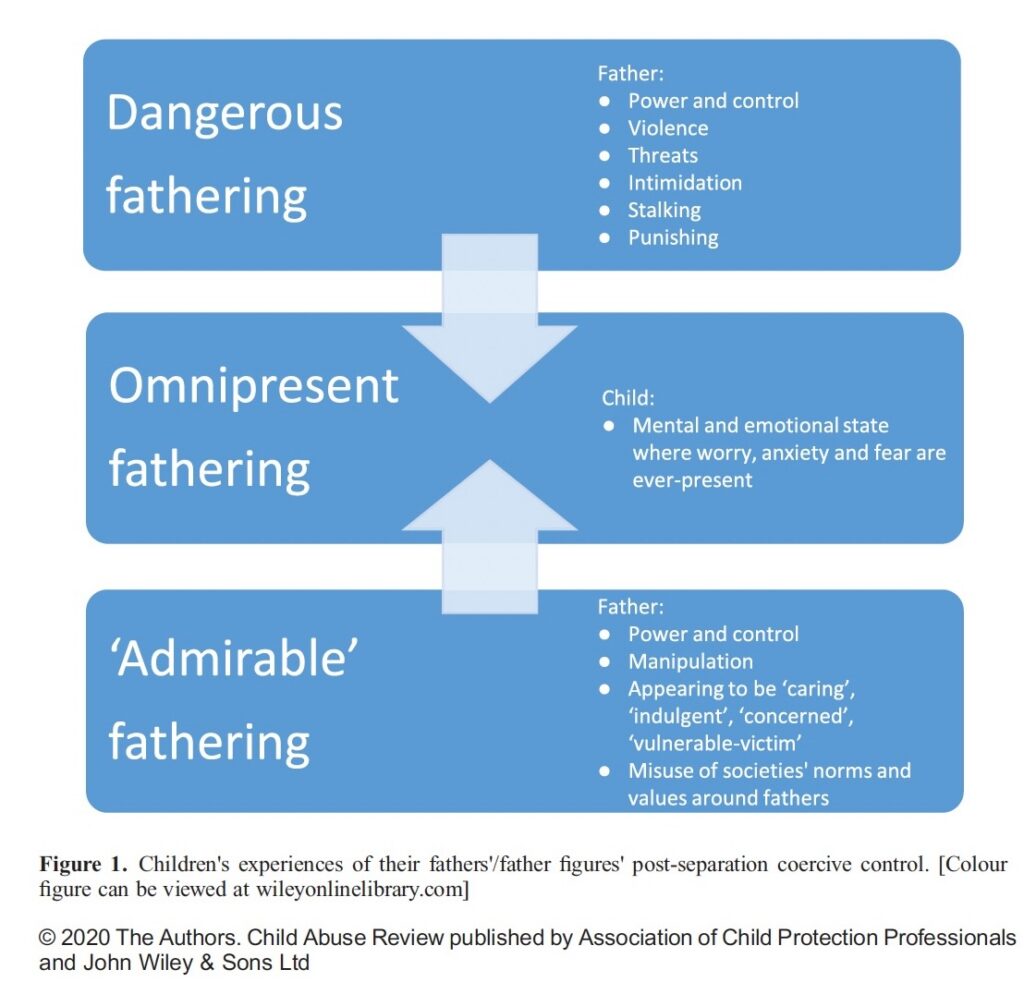
There were three overarching themes arising from the data: (1) dangerous
fathering; (2) ‘admirable’ fathering; and (3) omnipresent fathering. The themes
overlap. Dangerous fathering and ‘admirable’ fathering describe the different
kinds of acts that fathers/father figures used while perpetrating coercive control,
while omnipresent fathering occurred in children as a fearful mental and
emotional state (see Figure 1).
Findings
Dangerous Fathering
In both the UK and Finnish samples, therewere numerous accounts of perpetrators
performing ‘dangerous fathering’, including behaviours that were intrusive,
threatening and/or punishing, as part of their post-separation coercive control
(Monk, 2017; Thiara and Gill, 2012). These behaviours were largely, though not
always, hidden from professionals and others outside the immediate family.
Domestic intrusions and threatening behaviour by fathers/father figures
often involved banging on doors and windows while making death threats
against children’s mothers, or punishing behaviours against children
themselves: ‘When Dad was lurking in the garden he broke my plants and
chopped down my tree’ (Brock, UK).
Fathers’/father figures’ friends and proxies were another means of
threatening children and mothers:
‘He used to bring some other men and try and break into the house, and me and my
brothers feared for our lives because he used to smack on the doors, and I used to hide.’
(Vince, UK).
These intrusions could make children feel that their homes were ‘under
siege’ and less safe than public areas.
Some children had to live with the possibility that fathers/father figures
would target their pets, as this joint interview with Finnish siblings illustrates:
‘[The dogs] are in the doghouse and when we are at school, if he comes he might
feed them or release them…’ (Lotta, Finland); ‘… Or he can take them away’
(Liisa, Finland). Here Lotta and Liisa express concern about their dogs’
vulnerability while they are at school. Their father might feed them (a benign
activity) or take malicious action by releasing or abducting them.
Dangerous fathering could also create situations where children had to
abandon their home, school, friends, routines and local environments at a
moment’s notice. One boy in the UK sample described how he, his mother
and siblings had to move several times. Each move had forced the children
and young people to leave behind their home, friends and, on one occasion, their
dog. They had to ‘start over’ in each unfamiliar area, but their father persisted in
finding them. Similarly, a Finnish boy stated in his interview: ‘we have moved at
least a hundred times’. This negatively affected children and young people’s
educational achievement and their relationships with peers.
Some children also experienced fathers/fathers figures targeting dangerous
behaviour at relatives and professionals. Fathers/father figures appeared to
deploy this tactic to maintain control and dominance over children and expartners
by intimidating those trying to help them:
‘He went to [mother’s] workplace to threaten her… We couldn’t stay in our home or in
relatives’ homes so then we had to go to some other place. And then it started that everybody
who kind of helped [us], they got also death threats… In the end, in the refuge, the workers
also started to get those threats and he went there, raging outside the refuge.’ (Anu, Finland)
Such behaviour from perpetrators/fathers entraps children and mothers
(Stark, 2007), obstructing them from living normal lives or seeking help.
Anu’s quote conveys her and her mother’s options being reduced one by one, shrinking their worlds, until even a refuge was unsafe. Using narrative
devices – ‘and then…’, ‘in the end…’ – helped Anu to tell the story of what
had happened to her and her mother, a nightmarish journey that they had
both experienced.
These examples show how dangerous fathering could make children’s
lives frightening, constrained and unpredictable. Perpetrators’/fathers’
post-separation coercive control could make children feel that they, their
mothers and their pets were in danger. Many children and young people
were denied everyday experiences such as relaxing at home or attending
the same school each year. In some cases, children’s lives were disrupted
on multiple occasions as they and their mothers tried to escape
coercive control. Because of their fathers’/father figures’ actions, the
potential for loss and death was ever-present in children’s narratives. Thus,
children and young people were experiencing central aspects of coercive
control – living under threat, feeling fearful and living constrained lives
(Stark, 2007).
‘Admirable’ Fathering
In both the UK and Finnish samples, some children reported how fathers/father
figures performed ‘admirable fathering’ as part of their post-separation coercive
control. In the children’s narratives, ‘admirable’ fathering included their
father/father figure playing the roles of a caring, indulgent, concerned and/or
vulnerable-victim father. Performances of ‘admirable’ fathering were a powerful
tool of control when mixed with dangerous fathering, as ‘admirable’ fathering
increased father–child emotional bonds and could make children want to
see/live with their fathers, while dangerous fathering simultaneously made them
fearful of him (Enander, 2011; Monk, 2017; Thiara and Gill, 2012). This can be
especially confusing for younger children who often try to be loyal to both
parents (Nikupeteri and Laitinen, 2015).
One UK child, Grace, described her father performing what we term the
‘vulnerable-victim’ role during contact visits:
‘He’d say “oh your mum makes me cry”, he’d just paint such a bad picture of her… he
blamed her and us for everything… He said he was on antidepressants because I wasn’t
seeing him enough… I felt very small and bad… [After our weekend visit with our father,
my sister] would be off school most Mondays because she felt so ill, she was on the sofa
being held by mum and crying. He would call [my sister] and say “you’re the only one
who really loves me”.’ (Grace, UK)
Through his performance of being ill-treated by his family, this father
coerced his daughters into maintaining relationships with him that harmed their
wellbeing. Positioning them as responsible for his welfare, he disguised the
emotional power that he was wielding over them. Refusing to take
responsibility for one’s own mental health, as this father did, is the same
coercive control tactic that perpetrators often use with adult partners, especially
when they threaten to commit suicide if their partner leaves them (Monckton
Smith, 2019). This entraps their targets (Stark, 2007), as they feel obligated
to look after the perpetrators (see also Bancroft et al., 2012). Grace’s sister
Zoe described experiencing confused and hard-to-articulate feelings towards her father;
feelings also found by Thiara and Gill (2012) in children with
‘extremely manipulative’ fathers:
‘I was wanting him to stay or I was wanting him to go and so it was quite a bit, like, I just
wanted it to stop, to be honest, I wanted to like, just a bit, I don’t know, just, yeah.’ (Zoe, UK)
Performances of ‘admirable’ fathering were often targeted at professionals
and wider communities (e.g. school staff, other parents), and could occur
alongside fathers/father figures stalking, harassing and/or attacking ex-partners
and children when out of the public eye. These perpetrators’ apparent aim in
performing ‘admirable’ fathering to community/professional audiences was to
emphasise their role as ‘caring’, ‘concerned’, ‘indulgent’ and/or ‘vulnerablevictim’
fathers, making ex-partners seem like perpetrators or deficient mothers
(see Monk, 2017). For instance, two jointly interviewed Finnish siblings
described how their father had broadcast that their mother had kidnapped them:
‘He had written on Facebook…some kind of missing person’s report…that whoever finds
us or who knows where we are… something like that… he’ll pay ten thousand Euros …’
(Marko, Finland)
‘… Yeah, he claimed that our mother had kidnapped us and that there will be a reward for
the person who finds us.’ (Minna, Finland)
This father’s kidnapping claim had the impact of turning every member of the
public into his potential agent, adding additional layers of constraint and fear to
these children’s and their mother’s lives.
An important milestone for some children was recognising that their
father’s/father figure’s ‘admirable’ behaviour was manipulative or
unacceptable. This was difficult for children as it involved both seeing through
their father’s/father figure’s manipulation and perceiving their father/father
figure as harming their life – contradicting the culturally dominant image of
the good, loving father who enriches children’s lives (Harne, 2011; Monk,
2017). Some children who had come to recognise their father’s/father figure’s
manipulativeness began to demand higher standards of behaviour from him.
Sofia discussed no longer allowing her father to buy ‘[her] trust with money’
(see also Callaghan et al., 2018):
‘[My dad] has learnt to buy the trust with money and now it’s not possible to buy it with
money after this kind of thing [domestic violence]… I have also written to him that at this
moment you cannot buy my trust, it comes if it comes as time goes by. It depends on your
own behaviour whether you can get my trust or not.’ (Sofia, Finland)
Professionals working with children and young people can assist with this
process. One UK child, Grace (see earlier), discussed how a counsellor
had helped her to recognise and name her father’s attempts to emotionally
manipulate her, and this had changed her feelings about living with/seeing him:
‘I used to say sometimes years ago that I wanted to go and live with my dad… I stopped
seeing him a couple of years ago… I’m a lot closer to my mum now… I’ve spoken to two
counsellors. One gave me these exercises to help me see what Dad was doing [being
emotionally manipulative] and how people around me were trying to help me. That helped
my confidence. It made me realise that I could talk to people.’ (Grace, UK)
Grace’s interview suggests that her wellbeing has now significantly increased.
Recognising ‘what Dad was doing’ had contributed to her decision to cease
contact with him, freeing her from the distress of his coercive control.
Coercive control perpetrators sometimes ‘display what seems to be love and
care… as part of the abuse pattern’ (Enander, 2011, p. 29). With intimate
partners, this can involve gift-giving and claims that their behaviour is
motivated by protectiveness and deep love. The above descriptions by children
demonstrate how perpetrators/fathers can extend these coercive control tactics
to children and those outside the family (see also Monk, 2017). By appearing
indulgent, concerned or emotionally dependent on their children,
perpetrators/fathers disguised their ongoing use of coercive control as
‘admirable’ behaviour.
Omnipresent Fathering
Post-separation, many children in the samples came to feel that their
father/father figure was a constant, omnipresent figure, and this produced a
mental state where fear was ever-present. Children were (justifiably) afraid that
their father/father figure could appear anywhere, anytime, to harass,
manipulate, upset, kidnap and/or attack them or their mothers (see Thiara
and Humphreys, 2017). This caused physical manifestations of fear including
anxiety, panic attacks, bed-wetting and nightmares. Each time a father/father
figure appeared and behaved in a hostile way, he subjected his children to
numerous hours of anxiety and fear after he had gone. Through omnipresent
fathering, fathers/father figures maintained some control, domination and
emotional power over children even when not physically there.
This omnipresence leads to some children and young people monitoring
their surroundings continuously as a protective strategy: ‘I have it so that I
check that the doors are locked and windows closed’ (Lotta, Finland). Some
children and young people lived in a constant state of readiness (see Øverlien,
2013). They sought to increase their own and their mother’s security by
remaining with her: ‘Now sometimes I’ll sleep in my mum’s bed because I feel
more comfortable there and I feel more safe sleeping there’ (Bob, UK); ‘It was
sometimes even that we weren’t able to go to school…I didn’t want to leave my
mum alone for the day’ (Roosa, Finland).
Many children shared that their father’s/father figure’s power felt present
wherever they went and whatever they did. Some described their activities
being severely restricted by fear that he would locate them and cause harm:
‘I couldn’t go out that much until recently because I was scared my father
would try to kidnap me again and attack Mum again’ (Angel, UK).
Children’s experiences of omnipresent fathering further illustrate the direct
impacts of coercive control on children. Children’s narratives suggested that
omnipresent fathering can be described as the ‘psychological presence of the
father in the child’ (Krampe, 2009), undermining children’s liberty (Stark,
2007; Williamson, 2010) and their possibilities to act freely (Westmarland
and Kelly, 2013). This emphasises the importance of moving beyond an
incident-focused understanding of domestic violence (Katz, 2016) and instead
conceptualising it as a state of continuous entrapment (Stark, 2007). For some
children and young people, it was irrelevant that the last incident of violence or threat to kidnap them took place months or years ago; they still lived with
continual fear and constraint.
Discussion and Implications for Practice
Our findings present a concerning picture. Children’s accounts indicated that,
post-separation, coercive control-perpetrating fathers/father figures can
alternate between the dangerous father – intrusive, threatening and/or
punishing – and the ‘admirable’ father – an apparently caring, indulgent,
concerned and/or vulnerable-victim father unfairly separated from his children.
Dangerous fathering was experienced by children as perpetrators’/fathers’
physical, concrete acts of violent/threatening behaviour. The dangerous father
scared children and harmed them emotionally/psychologically, physically,
socially and educationally. Like dangerous fathering, ‘admirable’ fathering
was experienced by children through fathers’ concrete actions. The ‘admirable’
father made his children feel responsible for his welfare and/or increased their
affection for him through money and gift-giving. Sometimes appearing loving
and generous, he could trap children in father–child relationships that caused
them distress. Finally, the omnipresent father occurred in children as a mental
and emotional state; a state brought on by children’s real experiences of fathers’
dangerous and ‘admirable’ behaviours. The omnipresent father created
continual fear in children, and this restricted children’s liberty and freedom.
Overall, children often had to adapt and constrain their daily activities,
relationships and futures in response to their fathers’ coercive control, and
coercive control created harmful conditions of entrapment for children (Stark,
2007). We therefore suggest that children and young people should be
professionally supported in their own right during the post-separation phase
as coercive control victims/survivors.
Children’s accounts also point to the need for a more critical stance
towards fathers who have perpetrated coercive control, especially regarding
performances of ‘admirable’ fathering. Family courts may need to protect
children from contact or residency with domestic violence/coercive
control-perpetrating fathers (Bruno, 2015; Mackay, 2017; Radford and
Hester, 2015). To determine if children require protection from their fathers,
professionals could examine whether the father is still perpetrating coercive
control against the children and/or their mother through violence,
harassment, threats, intimidation and/or manipulation. If he is, this may
indicate that his performance of ‘admirable’ fathering is not genuine,
and is part of his ongoing coercive control (Bancroft et al., 2012;
Callaghan et al., 2018; Monk, 2017). This should be considered by
professionals even when a coercive control perpetrator has never used
physical violence, as there is some evidence to suggest that non-violent
perpetrators are as harmful as violent ones (Crossman et al., 2016; Stark
and Hester, 2019).
Our findings also imply the need for a more sophisticated understanding
of the relationship that children may, or may not, have and want with
fathers/father figures. Relationships with fathers/father figures are especially
complex when children suffer from coercive control but at the same time
miss their fathers/father figures, which may be the case especially with younger children
(Nikupeteri and Laitinen, 2015; Peled, 2000). Children
may become confused by fathers’/father figures’ contradictory ‘Jekyll and
Hyde’ behaviours (Enander, 2011) and find it hard to comprehend and
verbalise their experiences (see Øverlien, 2013; Thiara and Gill, 2012).
We suggest that professionals should be concerned when children of
coercive control-perpetrating fathers express views that are pro-father or
pro-contact with father, and should investigate whether children’s views have
been distorted by fathers. We are rightly used to interpreting an adult
victim/survivor as having been manipulated when she says: ‘it’s not his fault
that he gets angry’, ‘it’s not that bad’ or ‘I love him’. Yet we tend to see
children and young people’s perceptions as authentic and unproblematic
when they make similar kinds of statements (Bancroft et al., 2012). To
determine if children’s perceptions have been manipulated by fathers
(McLeod, 2018), professionals – for example, social workers, family court
judges, teachers or the police – need to be knowledgeable about the
complexity of children and young people’s experiences of coercive control.
This is especially important in light of adults’ responsibilities to help
children and young people to realise their rights for secure living
environments and abuse-free lives (UNICEF, n.d.).
We suggest that children should be given detailed, age-appropriate
information about coercive control before they make decisions or express
their views to family courts about having contact with a coercive controlperpetrating
father. Specialist domestic abuse services would be wellpositioned
to provide this information to children. This would require
additional funding to create resources focused on giving children and young
people the tools to understand:
the dynamics and tactics of coercive control
• positive uses of power and negative uses of power by a parent
• healthy and unhealthy parenting behaviours.
There are already programmes for children and young people with experiences
of domestic violence in the UK such as CEDAR (Sharp et al., 2011) and
DART (McManus et al., 2013). However, as yet, such programmes tend not
to explicitly cover the issues listed here in the present article, particularly as
it is only recently that research has developed directly focusing on children
and coercive control (e.g. Callaghan et al., 2018; Haselschwerdt et al., 2019;
Katz, 2016, 2019; Øverlien, 2013). With some adjustments to incorporate the
above issues, such programmes could help to equip children to understand,
and to be as safe as possible from, fathers’/father figures’ post-separation
coercive control.
Finally, there is a move internationally towards criminalising controlling
and coercive behaviour in family and intimate relationships (Stark and
Hester, 2019). However, thus far, these efforts have focused on situations
with adult perpetrators and adult victims. Our study suggests that there is
a need for such laws to acknowledge that coercive control can also be
perpetrated by a parent against a child under 16 years old, so that children’s
experiences as victims and survivors of coercive control gain greater
recognition.
Conclusion
This article is among the first to examine children’s own accounts of how
they experienced coercive control perpetrated by their fathers/father figures
post-separation. Their accounts highlight that, post-separation,
perpetrators/fathers can continue to target coercive control at children as
well as at their ex-partners. Fathers/father figures were sometimes overtly
frightening, dangerous and threatening, and sometimes appeared to display
more ‘positive’ and/or sympathy-eliciting behaviours. Like adult
victims/survivors, many of the children and young people were living under
conditions of constraint and entrapment (Stark, 2007), and coercive control
could severely harm their emotional/psychological, social and physical
wellbeing and their educational achievement. Some perpetrators/fathers
appeared to deploy public performances of being a ‘caring’, ‘indulgent’,
‘concerned’ and/or ‘vulnerable-victim’ father, thereby obscuring their
coercive control. Our findings suggest the necessity of: (a) identifying and
supporting children and young people as direct victims/survivors of coercive
control; (b) prioritising their rights to be free of this abuse; and (c)
developing much more robust responses to coercive control-perpetrating
fathers/father figures.
Acknowledgements
We thank the Mikkeli and Oulu chapters of the Federation of Mother and Child
Homes and Shelters. The Finnish study ‘Children’s Knowing Agency in
Private, Multiprofessional and Societal Settings – the Case of Parental Stalking
(CAPS)’ was funded by the Academy of Finland (grant no. 308470). The
webpage of the project is www.ulapland.fi/caps. The UK study was funded
by the Economic and Social Research Council (grant no. ES/I011935/1). We
also thank Joseph Maslen, Liverpool Hope University and all the children
and young people who participated in this project.